Four Two-Minute Wall Squats for Blood Pressure
Back flat against a wall, knees bent, held for two minutes, four times over, with two minutes of rest between holds. Three sessions a week, fourteen minutes each. In the largest pooled look at exercise and resting blood pressure, isometric training lowered it the most, and the wall squat ranked first among the isometric forms for the top number.
Why it works
An isometric exercise holds a muscle under load while the joint stays still, and the wall squat is the version that needs only a wall. The case for it rests on one large analysis and a run of small trials. Edwards and colleagues, in the British Journal of Sports Medicine in 2023, pooled 270 randomized trials with 15,827 participants, each comparing at least two weeks of an exercise programme against a group that did no training. Every mode lowered resting blood pressure. Aerobic training brought it down by about 4.5 mmHg systolic and 2.5 diastolic, dynamic resistance training by 4.6 and 3.0, high-intensity intervals by 4.1 and 2.5, and isometric training by 8.2 and 4.0. In the network ranking for systolic pressure, isometric work placed first, and among its sub-types the wall squat ranked highest. The trials behind that share one protocol, the one below: four two-minute holds, two minutes of rest between them, three days a week. Wiles and colleagues ran it at home in 28 men with normal blood pressure for four weeks (European Journal of Applied Physiology, 2017) and measured systolic down 4 mmHg and diastolic down 3. O'Driscoll and colleagues kept 24 unmedicated men with high-normal blood pressure on it for a year (Journal of Hypertension, 2022) and reported systolic down 8.5 mmHg and diastolic down 7.3. Lea and colleagues (European Journal of Applied Physiology, 2024) tested the part that matters for doing this at home: setting the squat depth by how hard each hold feels on a ten-point scale, with no heart-rate monitor and no lab test. The ten young adults prescribed that way had seated systolic down 9 mmHg and diastolic down 6 after four weeks. In a crossover of 21 healthy adults (Edwards and colleagues, European Journal of Applied Physiology, 2026), four weeks of wall squats lowered diastolic pressure by 4.8 mmHg and four weeks of handgrip by 2.5. Why a held squat does this is less settled than that it does. The explanations on offer involve how the autonomic nervous system and the vessel walls set pressure at rest, and the trials measure the blood pressure change far more closely than they test any one explanation. Then the limits. The wall squat trials are small, mostly four weeks long, and mostly in men, and the people in them had normal or mildly raised pressure and took no blood pressure medication. Most of them come from one research group at Canterbury Christ Church University, whose members also wrote the 2023 analysis. Blood pressure is a proxy: no trial of isometric training has counted heart attacks, strokes or deaths. A pragmatic trial of 542 adults with stage 1 or 2 hypertension doing the wall squat at home for six months (ISOFITTER, protocol published in NIHR Open Research) is under way, and as far as this library can find, its results are not yet out.
How to do it
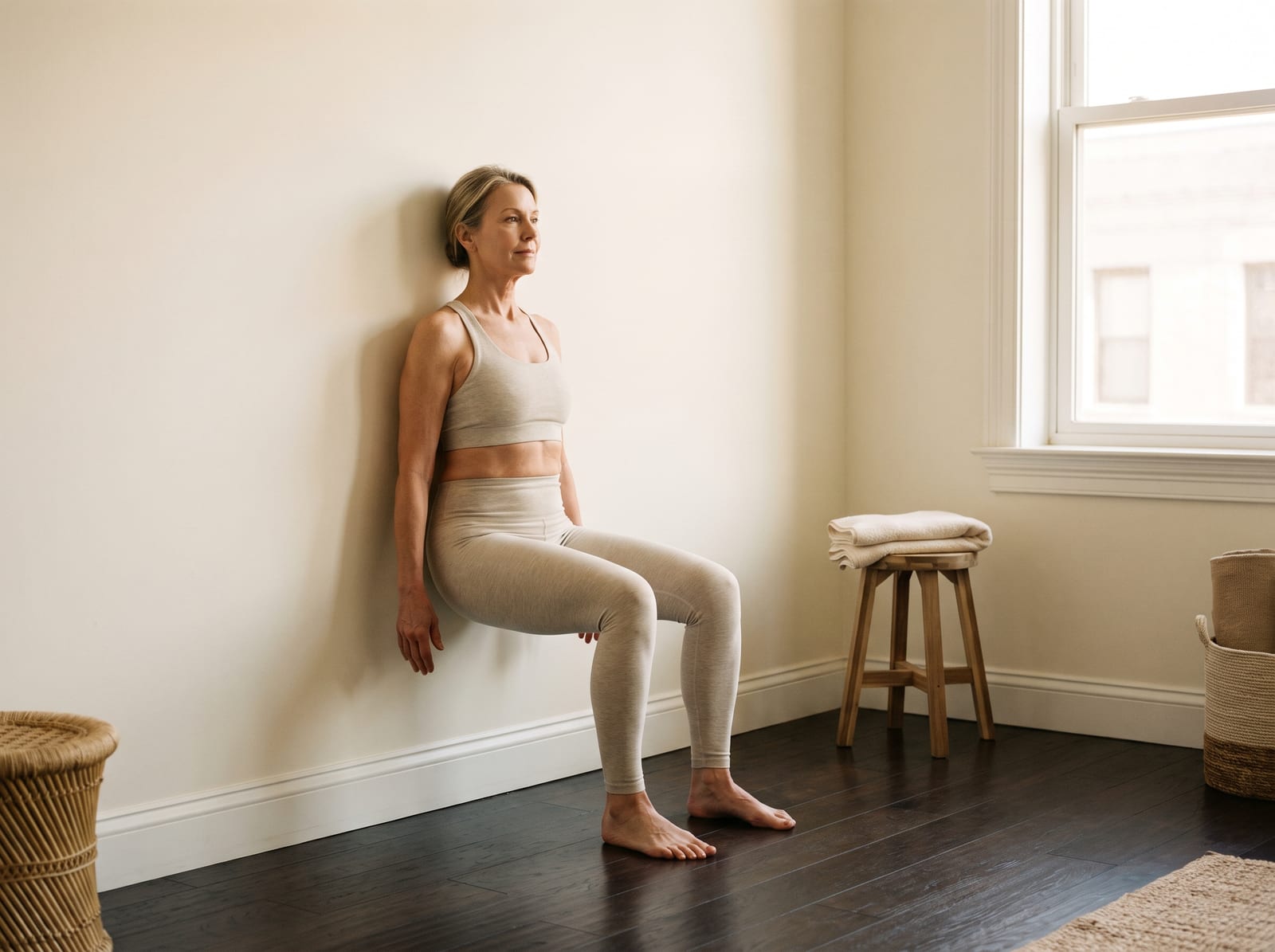
- Stand with your back against a smooth wall, feet hip-width apart and about two foot-lengths out from it. Shoes with grip, or bare feet on a floor that will not slide.
- Slide down the wall until your knees are bent to a depth you guess will feel like a 4 out of 10 by the end of two minutes, where 0 is no effort and 10 is the hardest you could hold. Knees stay over the ankles. Arms rest at your sides, off the thighs.
- Put a small piece of tape on the wall at the lowest point where your back touches it. That mark is your squat height for the session, which is how the home trial set it.
- Hold for two minutes. Breathe normally the whole time. If you catch yourself holding the breath, count the seconds out loud, which keeps air moving. Holding the breath pushes pressure higher.
- Stand up and rest for two minutes, walking or sitting.
- Repeat at the same height for four holds in total. The effort should climb across them: about 4 at the end of the first, 5 to 6 at the end of the second, around 7 at the end of the third, and 8 to 9 at the end of the fourth.
- If the last hold ends below 8, move the tape 1 to 2 centimetres lower for the next session. If it ends above 9, or you could not finish it, move the tape 1 to 2 centimetres higher.
- Repeat three days a week with at least a day between sessions.
Dose: 4 holds of 2 minutes, 2 minutes of rest between, 3 sessions a week with a day between. About 14 minutes a session. The trials ran from four weeks to twelve months, so give it four weeks before you compare home blood pressure readings.
⚠ Educational content for discussion with a clinician, not medical advice or a prescription. Keep taking any blood pressure medication as prescribed, and keep checking readings at home if you take it, since the two can add up. Pressure rises during the hold itself: in 26 unmedicated men with stage 1 hypertension doing this protocol, systolic peaked at 173 mmHg on average and reached 211 in one man, with diastolic peaking at 116 on average (Wiles and colleagues, Medicine, 2018). Get clearance first if you have heart disease, a heart rhythm problem, a stroke or heart attack in the past few months, or untreated high blood pressure, or if you are pregnant. The ongoing ISOFITTER trial left out people on beta-blockers and advised urgent medical review for any reading above 180/120. Breathe throughout, and stop for chest pain, dizziness, a building headache, or sharp knee pain.