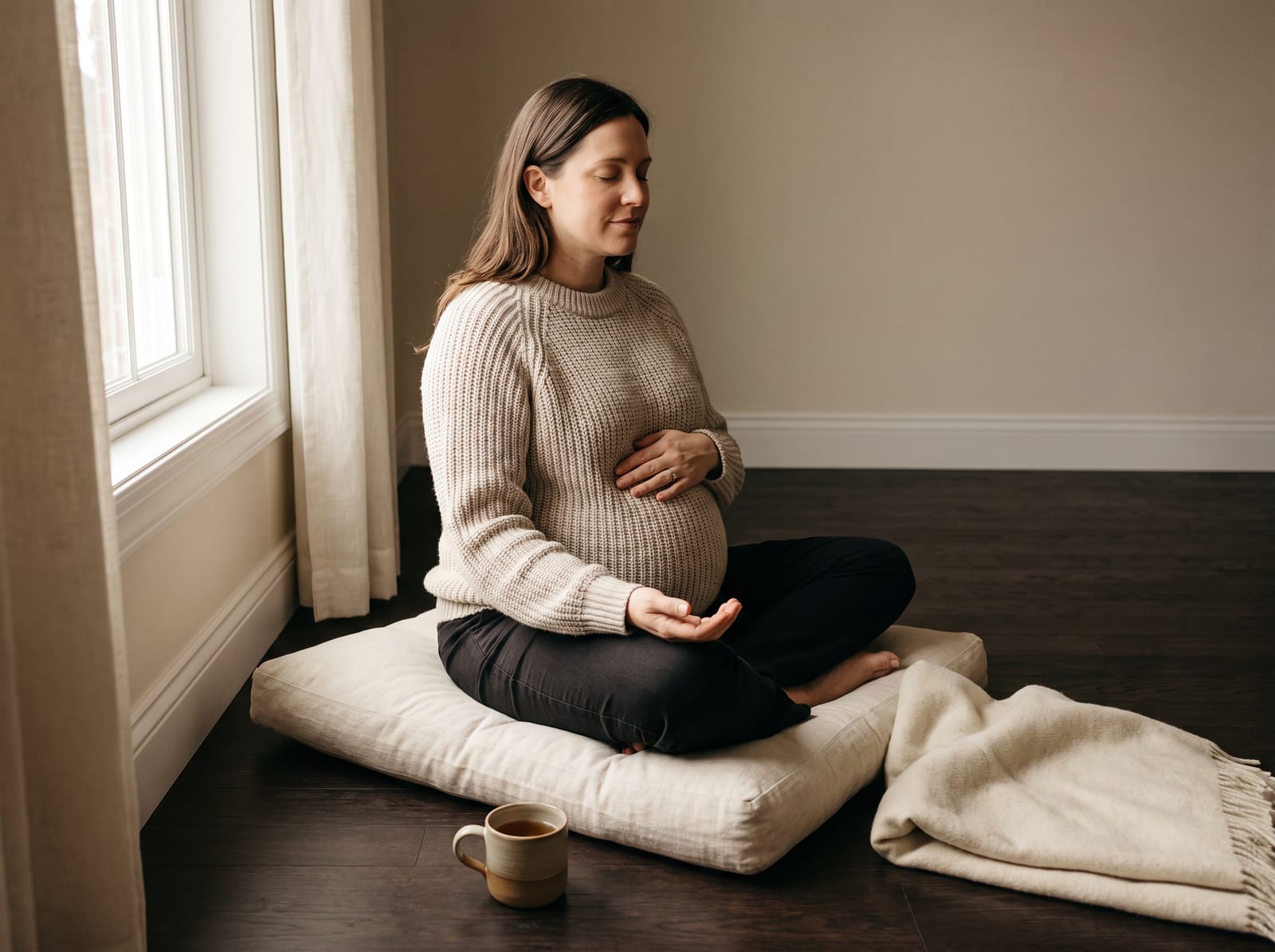
A Three-Minute Breathing Space for Pregnancy and After
Three minutes in three steps: notice what is here, gather attention onto the breath in the belly, then widen it to the whole body. It is the shortest practice in mindfulness-based cognitive therapy, the eight-week course two trials have taught to pregnant women who have been depressed before, and it is built to fit inside an ordinary day.
Why it works
Mindfulness-based cognitive therapy, or MBCT, was written by Zindel Segal, Mark Williams and John Teasdale for people who have recovered from depression and want to stay well. Its premise is that in someone who has been depressed before, an ordinary dip in mood can restart the old habits of thought that came with it: going over the same worry, judging yourself for feeling low, sinking further. The course trains noticing that shift early and stepping out of it. The breathing space is the portable version of that skill. Its shape is an hourglass. The first minute is wide: what thoughts, feelings and body sensations are here right now. The second is narrow: attention gathered onto the breath moving the belly. The third is wide again: the whole body, sitting or lying, breathing. Pregnancy and the months after birth are a stretch when depression that has happened before can come back, and they are also months with very little spare time, which is the reason a three-minute practice suits them. Sona Dimidjian and colleagues adapted MBCT for this stretch. Their version assigns the breathing space every day, a second form of it for hard moments, and an extension of the everyday practice they call being with baby. Why the course lowers relapse is less settled than the result. The pilot trial authors say plainly that they did not study the mechanism.
Two randomized trials tested the whole course, and the breathing space is one daily part of it. No trial has tested the breathing space on its own. The pilot: Dimidjian, Goodman, Felder, Gallop, Brown and Beck, Journal of Consulting and Clinical Psychology, 2016, volume 84, pages 134 to 145. Eighty-six pregnant women at Kaiser Permanente in Colorado and Georgia, up to 32 weeks along, each with a past episode of major depression and none in the previous two months, were randomized to eight weekly two-hour MBCT groups or to their usual care. Relapse was checked by structured interview at 8 weeks, a month before delivery, and at 1 and 6 months after birth. Counting everyone randomized, the estimated relapse rate through six months postpartum was 18.4% with MBCT and 50.2% with usual care (hazard ratio 3.87, 95% confidence interval 1.39 to 10.76). Women in the course reported home practice on about 30 of the 42 days it was assigned. Then the limits. Six women in the MBCT arm left before the groups started against one in usual care, the sample was mostly White, college educated and employed, and follow-up stopped at six months after birth. The larger trial, called UPWARD (NCT03623620), randomized 500 people with a history of depression who were well at the start to a 12-week digital version of the course, Mindful Mood Balance for Moms, plus usual care, or usual care alone. The results posted on ClinicalTrials.gov count relapse through six months postpartum in 81 of 249 people in the digital course (about 33%) and 111 of 251 in usual care (about 44%). As far as this library can find, those results are not yet in a peer-reviewed journal, and the posting gives no test of significance. Across mindfulness programmes in pregnancy more broadly, a 2017 meta-analysis (Dhillon, Sparkes and Duarte, Mindfulness, volume 8, pages 1421 to 1437) found no pooled difference in anxiety, depression or perceived stress in the randomized trials, with benefits showing up mainly in uncontrolled studies. The relapse result belongs to women with a past depression doing the full course.
How to practice
- Sit upright in a chair with both feet on the floor, or lie on your side with a pillow between the knees if sitting is uncomfortable later in pregnancy. Close your eyes or let the gaze rest on the floor.
- Minute one, becoming aware. Ask yourself what is here right now. Name the thoughts as thoughts (planning, worrying about the scan, replaying a conversation), name any feeling, and notice what the body is doing: tightness, tiredness, the baby moving. Change nothing. This minute is for seeing what is there.
- Minute two, gathering. Narrow your attention to the breath in the belly: the rise as air comes in, the fall as it goes out. Breathe at whatever pace the body chooses, with no counting and no holding. When the mind pulls away, notice where it went and come back to the next breath.
- Minute three, expanding. Widen your attention to take in the whole body at once: the posture, the face, the hands, the weight of the belly, as if the whole body were breathing. If one place is uncomfortable, let attention rest there for a few breaths and breathe with it.
- Open your eyes and choose the next thing you do on purpose, whether that is the next task, a glass of water, or a call to someone.
- Use it daily at a few times you pick in advance, tied to something you already do, such as after brushing your teeth or before lunch. Use it again in a hard moment: when a worry starts to loop, after a difficult appointment, or during a night feed once the baby is here.
- One minute per step is a guide. The shape matters more than the clock: wide, then narrow, then wide.
- A thought that keeps coming back is the practice working. Name it (worrying, planning) and return to the breath, as many times as it takes.
- The trial version added being with baby: the same attention brought to the baby's movements in pregnancy, and to feeding, holding or settling the baby after birth.
- The aim is noticing a low mood early, while it is still small. Feeling calm at the end is welcome and is a side effect.
⚠ Educational content to discuss with your midwife or obstetric clinician. This practice is one part of a course that was tested in women who were well when they started; it is a skill for staying well and does not treat depression that is already here. Keep taking any antidepressant as prescribed and talk to your prescriber before changing it. If low mood, loss of interest, or anxiety lasts two weeks or more, tell your care team, and if you have thoughts of harming yourself or the baby, contact emergency services or a crisis line now. The breath here is never held, and from the second trimester on, side-lying or upright positions are more comfortable than lying flat on your back. Sustained inward attention raises distress for some people, more often after trauma; open your eyes and stop if that happens.