Warm Salmon, Egg and Nori Rice Bowl
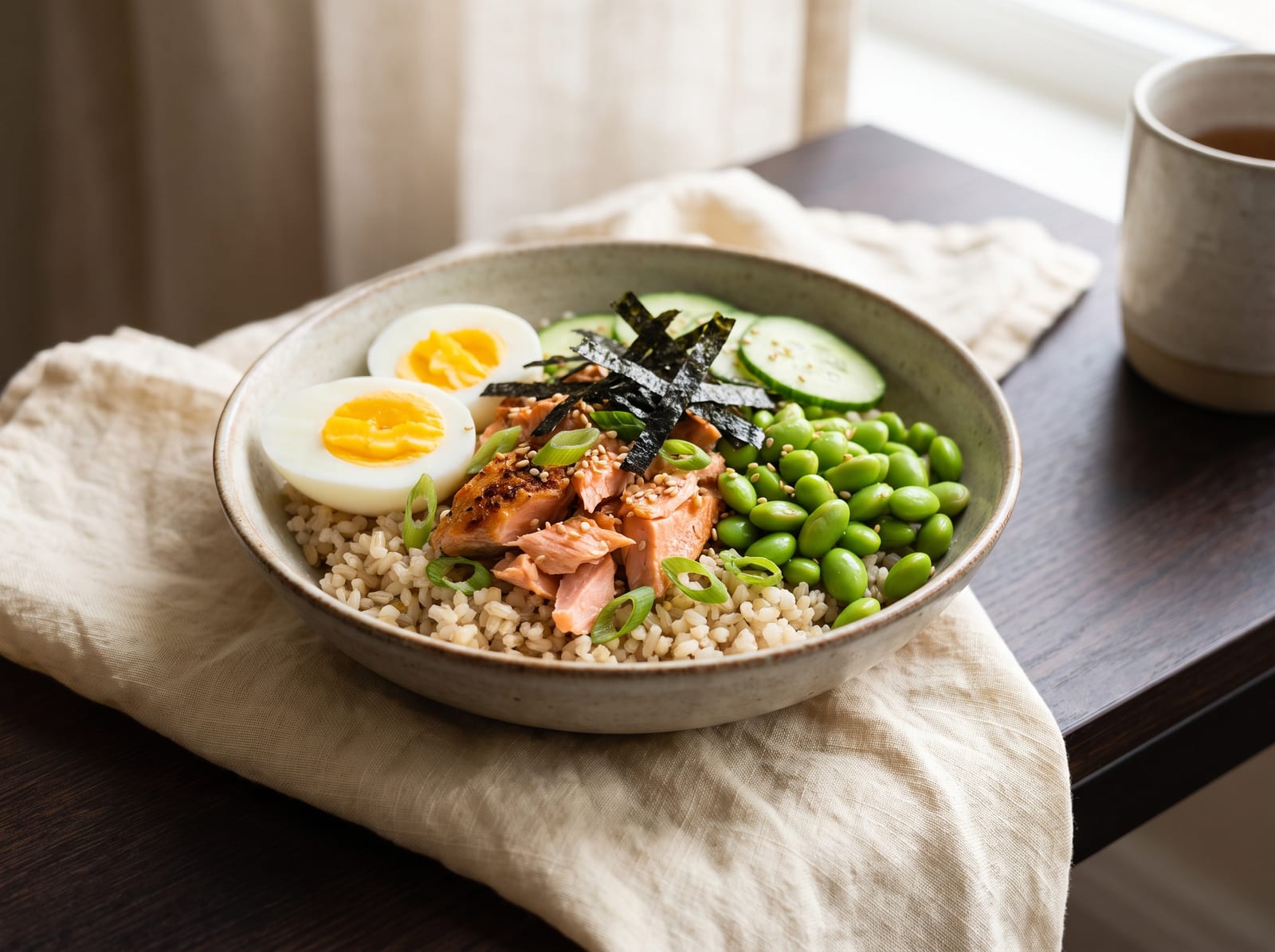
Roasted salmon flaked over short-grain rice with hard-cooked egg, edamame, cucumber and one torn sheet of toasted nori. It is the poke bowl rebuilt so that everything in it is cooked through, and the nori is measured rather than piled on.
Why it works
Pregnancy raises thyroid hormone output by roughly half and speeds up how fast the kidneys clear iodide, so the iodine requirement moves from 150 micrograms a day to 220 by the US National Academies and 250 by the WHO. The fetal thyroid does not contribute much of its own until somewhere between weeks 12 and 20, which means the first trimester runs on what the mother brought. The observational case is the ALSPAC cohort, Bath, Steer, Golding, Emmett and Rayman in the Lancet, 2013: 1,040 British mother and child pairs, where a first-trimester urinary iodine-to-creatinine ratio under 150 micrograms per gram predicted lower verbal IQ at age eight and lower reading accuracy and comprehension at age nine, after adjustment for a long list of confounders. The randomized test of the same question went the other way. Gowachirapant and colleagues, Lancet Diabetes and Endocrinology, 2017, gave 832 mildly to moderately deficient pregnant women in India and Thailand either 200 micrograms of iodine a day or placebo from before 14 weeks, and their children's IQ at five to six years came out the same in both arms. Nobody disputes what severe deficiency does. Mild deficiency, which is the version most of the developed world has, is where the picture stays unsettled. Salmon, eggs and dairy each carry some iodine. Seaweed is the concentrated form, and the quantity here is a deliberate choice. Dried nori is usually reported between 16 and 43 micrograms of iodine per gram, a wide enough spread that one toasted sheet of about three grams lands anywhere from roughly 50 to 130 micrograms depending on the sheet. Kombu runs into the thousands of micrograms per gram, and a kelp habit can carry someone past the 1,100 microgram daily upper limit for adults, at which point the problem inverts: too much iodine suppresses the fetal thyroid much as too little starves it. One sheet of nori rather than a handful of kelp is the reason the garnish is written down by count. The salmon is doing separate work. The Cochrane review by Middleton and colleagues, 2018, pooled 70 trials and close to 20,000 women and found marine omega-3 supplementation lowered birth before 37 weeks, a relative risk near 0.89, and birth before 34 weeks, near 0.58. Those are capsules rather than fish dinners, and the distance between the two is not something the trials close. The neurodevelopment half of that story is weaker: DOMInO, Makrides and colleagues in JAMA, 2010, randomized 2,399 women to DHA-rich fish oil and found no improvement in Bayley cognitive or language scores at 18 months. Salmon sits on the FDA and EPA Best Choices list at two to three servings a week, so the mercury arithmetic leaves room for this bowl. Everything here is cooked through, which is what separates it from the poke made of the same ingredients: listeria grows at refrigerator temperature in ready-to-eat chilled seafood, which is the category raw marinated fish sits in, and the eggs are hard-cooked rather than jammy because a loose yolk is a salmonella question worth skipping for nine months.
The 220 and 250 microgram figures are the US National Academies and the WHO, and the 1,100 microgram upper limit is the National Academies'. The link between low first-trimester iodine and children's verbal and reading scores is ALSPAC, which is observational and adjusted but cannot rule out that mothers with low iodine differed in other ways. The one adequately powered randomized trial of correcting mild deficiency, Gowachirapant 2017, found no difference in child IQ, so what a food-first approach buys in a mildly deficient population is unproven rather than established. The omega-3 result on preterm birth is the strongest evidence on this page, and it comes from supplement trials rather than from eating fish. The neurodevelopment claim people attach to prenatal DHA did not hold up in the largest trial of it, which is DOMInO. Nobody has tested this meal, or any single meal, against a pregnancy outcome.
Ingredients
- 8 oz (225 g) skin-on salmon fillet
- 1 1/2 cups cooked short-grain brown rice, warm
- 2 large eggs
- 1 cup shelled edamame, thawed
- 1 cup cucumber, thinly sliced
- 1 sheet toasted nori (about 3 g), torn into strips
- 2 scallions, thinly sliced
- 1 tablespoon low-sodium soy sauce or tamari
- 1 tablespoon rice vinegar (unseasoned)
- 2 teaspoons toasted sesame oil
- 2 teaspoons toasted sesame seeds
- 1/2 teaspoon finely grated fresh ginger
Method
- Heat the oven to 200 C (400 F). Pat the salmon dry, set it skin-side down on a lined sheet, and roast 12 to 15 minutes until it flakes and the thickest part reads 63 C (145 F) on a thermometer. Use the thermometer rather than the fork test here; undercooked fish is the one thing this bowl is built to avoid.
- While the salmon roasts, lower the eggs into simmering water and cook 9 to 10 minutes, until the white and the yolk are both firm. Cool them under cold running water, then peel and halve.
- Steam or boil the edamame for 3 to 4 minutes and drain.
- Whisk the soy sauce, rice vinegar, sesame oil and grated ginger in a small bowl.
- Divide the warm rice between two bowls. Flake the salmon off the skin over the top, then arrange the egg halves, edamame and cucumber around it.
- Spoon the dressing over both bowls and finish with the torn nori, sesame seeds and scallions. One sheet between two bowls is the amount; most of the iodine in this meal is in that garnish, and more of it is not better.